As many of you probably know, in The Hitchhiker's Guide to the Galaxy by Douglas Adams, the supercomputer spent 7.5 million years calculating the answer to the Ultimate Question of Life, the Universe, and Everything, and finally produced the now-famous answer:
42.
The beauty of the story is that the people asking the question only knew they wanted the Ultimate Answer, but they had never managed to formulate the question precisely enough for the answer to have any real meaning. As a result, they probably received a perfectly correct—but completely useless—answer.
With ORA AI, the situation is different.
We ask a very specific question:
Where will the trend go?
And, just as importantly,
On which instrument and at what price level should we expect it?
As we've said before, we love "difficult" trades.
Yesterday was another excellent example.
Multiple groups of trades across different currency pairs all closed in profit.
The system gave the correct answer.
However, there was one exception.
The very first trade in one series was closed with a loss.
Whenever these rare situations occur (roughly 3–5% compared to the other 95–97% successful trades), we always take the time to examine an alternative scenario:
What would have happened if we had simply left that position open?
To be clear, the day was already highly profitable. The entire basket produced more than three times the desired profit, and every basket finishing in profit is one of our fundamental requirements.
But these rare "sticky" trades often tell an interesting story.
Had we simply waited longer—say, another 24 hours and carried the position into the next trading day—it would very likely have closed in profit as well, or at least reduced the loss to something almost negligible.
In other words, instead of finishing the day with a large overall profit and one small losing trade, we might have finished with virtually nothing but profitable trades.
This raises an interesting question.
What exactly was ORA AI trying to tell us?
Perhaps the answer produced by the AI is not always the simplified version that we naturally expect.
Our question is simply:
"Will the market reach this level?"
Notice what this question doesn't include.
It says nothing about whether it will happen within one minute, one hour, or even the same trading day.
Interestingly, we have performed extensive research on incorporating time into the model.
It simply didn't improve the results.
For our calculations, time behaves more like a source of mathematical noise than a fundamental variable.
A small secret from our research. 🙂
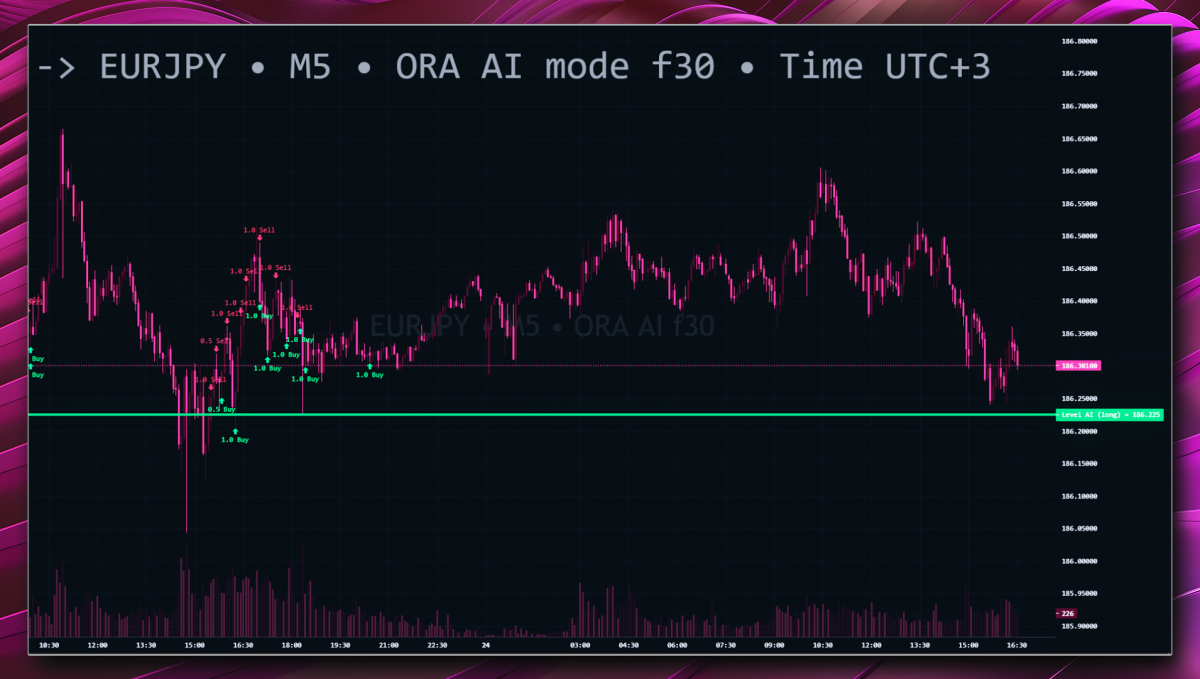
And now, almost 24 hours later, we are once again seeing exactly the same picture.
The price has returned and is now extremely close to that one "bad" trade.
And honestly?
Based on the statistics we've accumulated, I'm even willing to make a bet:
The market will cross that level as well.
